
We all say it. “I’m stressed.” Someone asks how you are doing and before you even think about it, those two words come out. It is almost a reflex in Nigeria. Work is piling up, the bills are not waiting, family has needs, and your body and mind are carrying it all.
But here is a question worth sitting with: what if what you are feeling is not just stress? What if it is something deeper, something that will not disappear after a long sleep or a weekend off?

Stress, anxiety, and depression are three of the most common mental health experiences people go through. They are also three of the most misunderstood. People use the words interchangeably, and that confusion often stops people from getting the right kind of help.
So let us break it down in plain, honest language.
What Is Stress?
Stress is your body and mind responding to pressure. It is not a bad thing on its own. When you have a presentation at work, a deadline, or a difficult conversation ahead of you, stress is your system gearing up to handle it. That is normal and healthy.
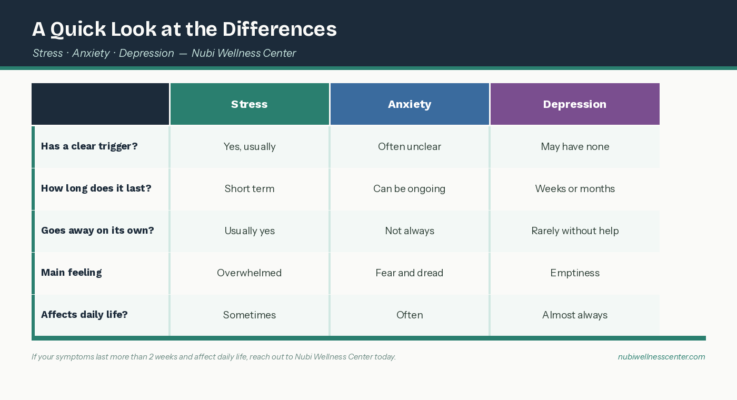
The key thing about stress is that it is situational. There is usually a clear cause you can point to, and once that situation is resolved or eases up, the stress tends to ease too. After the exam is done, you breathe. After the crisis passes, you feel relief.
Signs of stress include feeling irritable or short-tempered, having trouble sleeping, feeling physically tense, finding it hard to concentrate, and generally feeling overwhelmed. Sound familiar? Most of us have been here.
Think of stress as a fire alarm. It goes off because something needs your attention. Once you deal with it, the alarm stops.
What Is Anxiety?
Anxiety is a different experience entirely. With anxiety, the alarm does not stop. Even when things are calm, even when there is nothing obviously wrong, the worry keeps going. Your mind is stuck in a loop, bracing for something bad to happen, even if there is no real threat in sight.
People with anxiety often describe a sense of dread that they cannot explain. The racing heart, the tight chest, the thoughts that spiral at 2am about worst-case scenarios. It is exhausting because your body is in fight-or-flight mode on a regular basis, not just when things are difficult.
Unlike stress, anxiety does not always have a clear trigger. You might be safe, loved, and doing well by all outward appearances, and still feel consumed by fear and worry. That disconnect is one of the most isolating parts of anxiety.
Think of anxiety as a smoke detector that keeps going off even when there is no fire. Your body is responding to a threat your mind has imagined, and it feels just as real.
What Is Depression?
Depression is often described as sadness, but that description does not quite capture it. Many people with depression do not feel particularly sad. They feel nothing. A heaviness. A grey. Things that used to bring joy no longer feel interesting. Getting out of bed takes enormous effort. Simple tasks feel impossible.
Depression affects your thoughts, energy, sleep, appetite, and sense of self. It can make you withdraw from people, lose motivation, and feel like a burden. It often comes with a quiet but persistent voice that says things will not get better.
What makes depression different from a rough patch is duration and impact. Everyone has low days. But when that low lasts for weeks or months, and it starts affecting your ability to function, that is when we are talking about depression.
Think of depression not as feeling too much, but as feeling too little. It is the absence of colour in a life that used to have it.
Why This Matters in Our Context
In Nigeria, there is still a tendency to explain mental health struggles through the lens of spiritual attack, laziness, or weakness of character. People are told to pray harder, shake it off, or that others have it worse. Families suffer in silence because asking for help feels like bringing shame.
But none of these three things, whether stress, anxiety, or depression, are signs that you are not strong enough or faithful enough. They are signs that you are human, that your mind and body are under a load they need help carrying. There is no shame in that. None at all.
Understanding the difference between them matters because the support for each is different. Stress might respond well to rest, boundaries, and lifestyle changes. Anxiety often benefits from therapy and sometimes medication. Depression almost always requires professional care to truly heal.
When Should You Reach Out?
If you have been feeling off for more than two weeks and it is not getting better, that is worth paying attention to. If your mood or worry is affecting your sleep, your work, your relationships, or your sense of who you are, please do not wait it out alone.
And if you have had any thoughts of harming yourself or feeling like life is not worth living, reach out today. Not tomorrow. Today.
You do not need to have everything figured out before you make the call. You do not need to know exactly what you are experiencing. That is our job. Your job is just to take the first step.
At Nubi Wellness Center, we are here for exactly this.
Whether you are overwhelmed with stress, caught in a cycle of anxious thoughts, or feeling the heavy quiet of depression, we offer a safe and professional space where you can get real support. Our team understands the Nigerian experience. We understand the culture, the pressures, and the conversations that are hard to have.
You do not have to figure this out alone. Reach out to Nubi Wellness Center today, and let us take it from here together.
Click here to follow us for more health tips on.

This is quite insightful and helpful. Thank you for sharing.
Pingback: Understanding Anxiety: Causes, Symptoms, and When to Seek Help – Nubi Wellness Center