
|5 minutes read
Every September, or January depending on your school calendar, something shifts in your home. The backpacks come out. The school shoes get polished. The uniforms are pressed and laid out the night before. And somewhere in the middle of all that preparation, your child becomes a different version of themselves.
Maybe they stop eating properly at mealtimes. Maybe they start complaining of stomachaches every single morning. Maybe they cling to you in ways they have not done since they were much younger, or they cry without being able to explain why. Maybe they go very quiet. Maybe they tell you flat out that they do not want to go back to school.
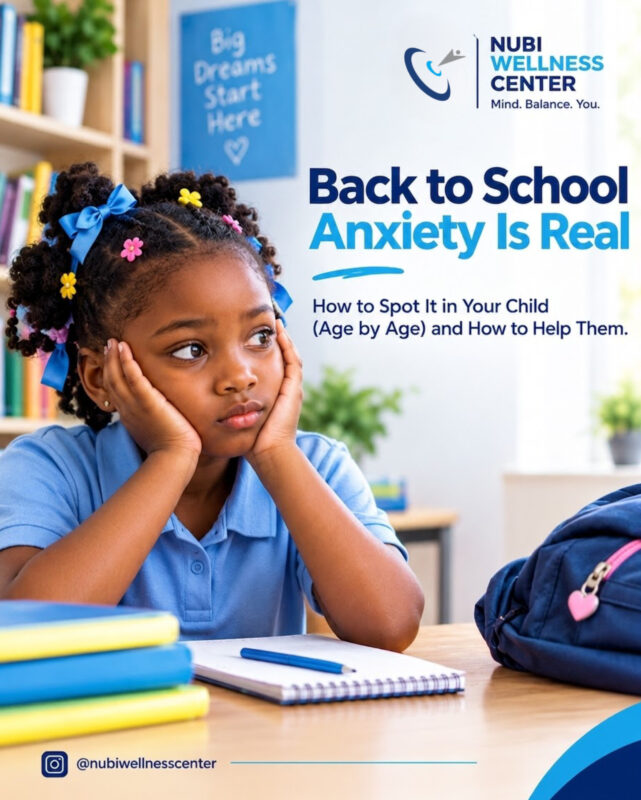
What you are watching is back-to-school anxiety. And it is far more common in Nigerian children than most parents realise.
It is not stubbornness. It is not laziness. It is not your child “forming” or looking for a way to avoid responsibility. It is a very real emotional and physical response to the pressure of returning to a school environment. New teachers. New classmates. Academic expectations. Social dynamics. The sudden loss of the freedom that came with the holiday. For many children, the thought of re-entering all of that at once is genuinely overwhelming, even if they cannot put it into those words.
As a parent, your first instinct is usually to reassure them. To tell them they will be fine. To remind them that they have done this before. And while that reassurance comes from a place of love, the most helpful thing you can actually do starts with understanding what anxiety looks like at your child’s specific age. Because it does not look the same in a five-year-old as it does in a fifteen-year-old.
This article will walk you through exactly that.
Please Note
Back-to-school anxiety is not a sign that your child is weak or that you have failed as a parent. It is a signal that your child needs a little more support than the school bag and packed lunch you have already prepared.
What Is Back-to-School Anxiety?
Anxiety is the body’s built-in alarm system. It is the brain’s way of signalling that something unfamiliar or potentially threatening is approaching. In children, this alarm is often triggered by transitions. A new school year. A new class. A new teacher. Or simply the return to an environment that previously felt stressful or difficult.
Back-to-school anxiety is not a clinical diagnosis on its own. It is a pattern of worry, fear, and physical discomfort that shows up around the beginning of a new school term. For some children, it is mild. A few butterflies in the first week that settle down once routines kick in. For others, it is intense enough to cause physical symptoms, emotional outbursts, or even outright refusal to attend school.
Some children have always carried a tendency toward anxiety and the new school term simply gives that anxiety a fresh target. Others are experiencing it for the first time, often after a difficult year academically or socially. And for some children, a specific event planted a fear of return that they may not even be able to name themselves. Being bullied. Failing an important exam. Losing a close friend from their class. Feeling humiliated in front of their peers.
The one thing that is true across all of these children is this: what they are feeling is real. And they need you to see it before you can help them through it.
What Back-to-School Anxiety Looks Like at Every Age
One of the most important things to understand about anxiety in children is that they do not always have the vocabulary to describe what they are feeling. Their anxiety tends to come out as behaviour rather than words. As a parent, you are not necessarily looking for a child who says “I am anxious.” You are looking for changes in behaviour, sleep, appetite, and mood that tell you something is going on underneath the surface.
Here is what to watch for at each stage of your child’s development.
Ages 3 to 5: Preschool and Early Primary
Children at this age are still developing the ability to understand and name their emotions. They often cannot tell you they are scared. What you will see instead is behaviour that looks like regression or clinginess, and physical complaints that seem to have no clear medical cause.
- Crying intensely at drop-off and refusing to let go, even well into the school term
- Regression in skills they had already mastered, such as bedwetting, thumb sucking, or baby talk
- Nightmares, difficulty falling asleep, or wanting to sleep in your bed again
- Frequent complaints of stomachaches or headaches on school mornings
- Increased meltdowns and irritability, especially the evening before a school day
- Significant loss of appetite around school days
What your child is really communicating: “I do not feel safe when you are not there. I do not know if you will come back. This place feels too big and too overwhelming and I need you close.”
Ages 6 to 8: Lower Primary
Children at this stage are becoming more socially aware. They are beginning to understand how others perceive them, and they care deeply about fitting in, being liked by their classmates, and doing well academically. Anxiety at this age often centres around performance and a fear of not belonging.
- Frequent stomachaches or headaches on school mornings that seem to disappear on weekends
- Asking the same worried questions repeatedly even after you have answered them calmly, such as “what if I do not know anyone in my new class” or “what if the teacher is strict”
- An increased need for reassurance, wanting more hugs than usual, asking you to promise things will be okay
- Dragging their feet when getting ready for school, conveniently forgetting things that cause delays
- Changes in sleep patterns, including difficulty falling asleep, waking up early with worry, or bad dreams
- Becoming tearful or unusually quiet in the days leading up to school resumption
What your child is really communicating: “I am afraid of being embarrassed in front of others. I want to do well and I am not sure I can. I do not know if everything will be okay without you watching over me.”
Ages 9 to 11: Upper Primary
At this stage, friendships become extremely important. Children are forming stronger social identities and anxiety often shows up around peer dynamics, academic pressure, and how they are perceived within their social group. They may also be preparing for the transition to secondary school, which carries its own weight.
- Withdrawing from family conversations and spending more time alone
- Excessive worrying about grades, test performance, or whether they are smart enough
- Overreacting to small mistakes, becoming very distressed over a wrong answer or a poor score
- Difficulty concentrating even when they are genuinely trying to focus
- Stomachaches and headaches that cluster specifically around school days but disappear at weekends
- Loss of appetite or noticeable changes in eating habits before school resumes
- Saying they want to change schools or claiming to hate school without being able to explain a specific reason
What your child is really communicating: “I am watching myself constantly and judging what I see. I am terrified of getting something wrong. I do not know quite where I belong and that uncertainty is exhausting.”
Ages 12 to 15: Junior Secondary
Adolescence brings a whole new layer of complexity. The social world in secondary school can be intense, and for many teenagers, school is where the vast majority of their emotional life plays out. Anxiety at this age can look very different from what you expect. It can present as anger, defiance, complete emotional shutdown, or excessive time on the phone.
- Sudden changes in friend groups or withdrawing socially, saying things like “nobody likes me” or “I have no real friends“
- Increased irritability and anger, especially on Sunday evenings and Monday mornings before school
- Avoiding school activities such as sports day, group projects, or social events
- Physical symptoms including headaches, nausea, dizziness, and chest tightness that appear before school
- A noticeable drop in academic performance that cannot be explained by ability or effort alone
- Excessive phone use as a way of escaping from real-world social pressure
- Expressing feelings of dread about the school term or saying things like “what is even the point”
What your child is really communicating: “The social world at school feels like too much to manage. I am trying to hold many things together at once. I do not know how to ask for help without looking like I cannot cope.”
Ages 16 to 18: Senior Secondary
At this stage, anxiety is very often tied to the future. WAEC. JAMB. University applications. Parental expectations. Career pressure. The stakes feel enormous, and the anxiety that comes with all of that can become paralysing in ways that look from the outside like apathy, laziness, or simply not caring.
- Perfectionism and intense self-criticism, spending hours on an assignment and never feeling it is good enough
- Procrastination as a coping strategy, avoiding starting tasks because starting means risking failure
- Physical anxiety symptoms before exams or presentations, including a racing heart, sweating, trembling, or shortness of breath
- Expressing vague but persistent fear about the future: “I am going to fail,” “I do not know what I am doing,” “nothing will work out for me”
- Seeming emotionally flat or disconnected from things they previously cared about
- Significant and sustained changes in sleep and appetite
- Completely withdrawing from family and avoiding any conversations about school or results
What your child is really communicating: “Everything feels like it is riding on this one period of my life. I am terrified of disappointing the people who have sacrificed for me. I do not know if I am enough.”
How to Help Your Child Through Back-to-School Anxiety
Knowing what anxiety looks like is the first step. Knowing what to do with that knowledge is the next. Here are practical, realistic things you can do to support your child through this season.
Start the Conversation Early
Do not wait until the Sunday evening before school resumes to check in with your child. Start the conversation one or two weeks before term begins, while there is still enough time to address what comes up. Keep it open and curious rather than interrogative.
Instead of asking “are you ready for school,” try asking “what are you most looking forward to this term?” And if they respond vaguely or go quiet, follow up gently: “Is there anything you are a bit nervous about? Even something small?” Giving your child space to name their worry before school starts means it does not build silently until it erupts on the morning of the first day.
Validate What They Are Feeling Without Minimising It
It is very natural to want to say “you will be fine” because you genuinely believe that, and because you want to make their distress stop. But to an anxious child, those words can feel like their worry is being dismissed before it has even been heard.
Try something different. Try: “I can see that you are worried about this. It makes sense that it feels a bit scary. Tell me more about what is on your mind.” Validation is not the same as agreement. You are not confirming that the danger is real. You are confirming that their feeling is real, and that is what helps a child feel safe enough to keep talking to you.
Re-establish Routines Before School Resumes
Anxiety thrives in uncertainty and disruption. The more predictable and consistent your child’s daily environment is, the more their nervous system can begin to settle. In the week before school starts, gradually shift bedtimes and morning wake-up times back toward the school schedule. This is not about being rigid. It is about giving your child’s body and brain time to adjust gently rather than all at once.
Teach Them One Simple Tool to Manage the Feeling
You do not need to be a therapist to give your child something practical that helps in the moment. One of the simplest and most effective tools is box breathing. Breathe in for four counts, hold for four, breathe out for four, hold for four. Repeat four times.
Teach it to them before school starts. Practise it together so it feels normal and not strange. Encourage them to use it when they feel the anxiety rising, on the way to school, before walking into a classroom, before sitting down for an exam. Small tools used consistently can make a real difference.
Stay in Communication With the School
If your child’s anxiety is significant, consider letting their class teacher or school counsellor know before term begins if possible. You do not need to share every detail. Simply saying “my child tends to feel nervous at the start of a new term and may need a little extra reassurance in the first few weeks” can change how a teacher responds to your child in those critical early days. Teachers who know are teachers who can help.
Know When It Has Gone Beyond Normal Nervousness
Some level of back-to-school nervousness is completely normal and does not require intervention beyond parental support. But there are signs that suggest what your child is experiencing needs professional attention:
- They are refusing to attend school consistently, not just on one or two difficult mornings
- Physical symptoms like headaches, nausea, and stomachaches are frequent and have no medical explanation
- Their anxiety is significantly disrupting their sleep, appetite, or ability to function day to day
- They are expressing hopelessness, speaking very negatively about themselves, or withdrawing from everything
- The anxiety has persisted for more than two to three weeks after school reopened with no signs of easing
If you are seeing these signs in your child, please do not wait and hope the situation resolves itself with time. Early support makes a meaningful difference to long-term outcomes.
When Professional Support Is the Right Step
If your child’s anxiety is persistent, intense, or beginning to interfere with their daily life and learning, a child psychologist or mental health professional can help. Therapy is not a last resort. It is a resource. And reaching for it early is one of the most protective things you can do for your child’s mental health and academic future.
A Word to Nigerian Parents
In many Nigerian homes, there is an unspoken expectation that children should be strong. That they should push through difficulty without complaint. That talking about feelings is not something children, especially boys, do openly. That anxiety is something children from other cultures experience, not ours.
But anxiety does not check your child’s background before it arrives. It does not skip Nigerian children. It does not respect academic ability, family circumstances, or how well you have provided for your family. It is a human experience, and your child deserves support regardless of what seeking that support might look like to those around you.
Recognising that your child is struggling and choosing to get them help is not weakness. It is wisdom. It is love expressed in one of its most practical and powerful forms.
How Nubi Wellness Center Can Help
At Nubi Wellness Center in Surulere, Lagos, we work with children, adolescents, and the families who love them. We understand the specific pressures that Nigerian children face, the academic expectations, the family dynamics, the social environment of Nigerian schools, and we bring that understanding into every conversation.
If your child is struggling as this school term begins, or if you are simply not sure whether what you are seeing is cause for concern, we would love to hear from you. A conversation costs nothing. And it could be one of the most important steps your family takes this term.

You Do Not Have to Carry It Alone
If this post resonated with you, our team at Nubi Wellness Center is here to walk with you through your healing journey. Reach out today, in confidence and without judgment.
Chat With Us on WhatsApp Visit Our Website09070990088 / 07054109566 • Every Story Matters. Every Healing Journey Counts.