
| 3 minutes read
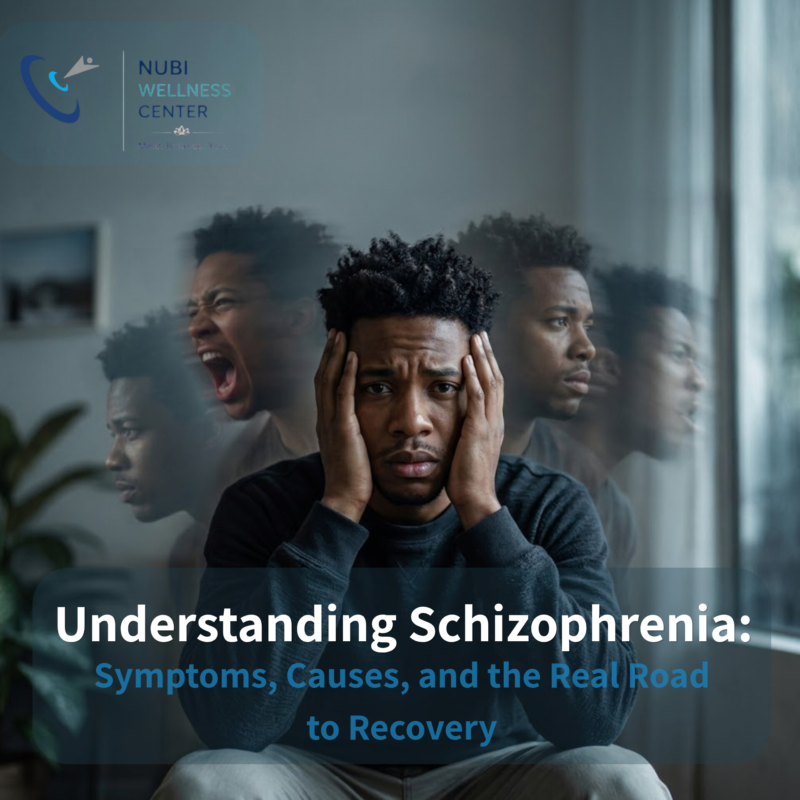
Few words in mental health carry as much weight, and as much misunderstanding, as “schizophrenia.” It shows up in movies as a villain’s backstory and in everyday conversation as a careless joke about being “of two minds.” The reality is far more human, and far more treatable, than the stereotypes suggest.
Schizophrenia is a chronic brain condition that changes how a person thinks, feels, and experiences the world. At its core is psychosis, a state in which the line between one’s own thoughts and actual reality becomes hard to hold onto. It affects roughly 1 in 300 people globally, and it typically first appears in late adolescence or early adulthood, often the early to mid-twenties for men and the late twenties to early thirties for women.
At Nubi Wellness Center, we meet people at every stage of this journey, from families noticing the first quiet changes to individuals years into stable, independent lives. This piece breaks down what schizophrenia actually is, so that fear and stigma give way to understanding.
The Three Pillars of Schizophrenia Symptoms
Schizophrenia is not just “hearing voices.” Clinicians group its symptoms into three categories, and most people experience a mix of all three at different points.
Positive Symptoms: Experiences Added to Reality
These are experiences that appear in someone with schizophrenia but are absent in the general population.
- Hallucinations. Sensing things that are not there. Auditory hallucinations, such as hearing critical or commentary style voices, are the most common, though any sense can be affected.
- Delusions. Firm, unshakeable beliefs with no basis in reality, held even in the face of clear counter-evidence. Common patterns include paranoia (believing one is being watched or targeted) and grandiosity (believing one has extraordinary powers or a unique identity).
- Disorganized thinking and speech. Difficulty organizing thoughts, which can show up as jumbled speech, rapid topic jumps, or answers that miss the point of a question entirely.
- Unusual motor behavior. This can range from childlike silliness to sudden agitation, or catatonia, where a person stays still, mute, and unresponsive for extended periods.
Negative Symptoms: Capabilities That Feel Taken Away
These involve a decrease in normal emotional and behavioral function, and they are often mistaken for laziness or bad attitude when they are, in fact, symptoms of illness.
- Flat affect. A monotonous tone of voice paired with minimal facial expression or eye contact.
- Avolition. A severe lack of drive to start or finish daily tasks, including basic hygiene or work.
- Social withdrawal. Gradual pulling away from friends, family, and community life.
- Anhedonia. Losing the capacity to feel pleasure or interest in things that were once enjoyable.
Cognitive Symptoms: The Hidden, Disabling Layer

These symptoms are often the most disruptive to daily life over the long term, because they affect how a person processes information.
- Trouble focusing, paying attention, or holding onto information
- Difficulty planning, deciding, or carrying out logical, step-by-step tasks
What Causes Schizophrenia?
There is no single cause. Research points to an interplay of several factors working together, often in a person who was already biologically vulnerable.
- Brain chemistry. Imbalances in neurotransmitters such as dopamine, serotonin, and glutamate disrupt how brain cells communicate with each other.
- Genetics. The condition can run in families. If an identical twin has schizophrenia, the other twin has roughly a 50 percent chance of developing it too. Still, most people diagnosed have no family history at all, so genes are only one part of a larger picture.
- Environment. Prenatal complications, severe childhood trauma, chronic high stress, and heavy cannabis use during adolescence are all strongly linked to triggering the condition in someone already vulnerable.
Diagnosis and Treatment
There is no blood test or scan that diagnoses schizophrenia on its own. A psychiatrist or licensed clinical psychologist arrives at a diagnosis through a full psychiatric evaluation, careful observation of symptoms over time (typically a minimum of six months), and tests that rule out other causes such as substance use or a medical condition.
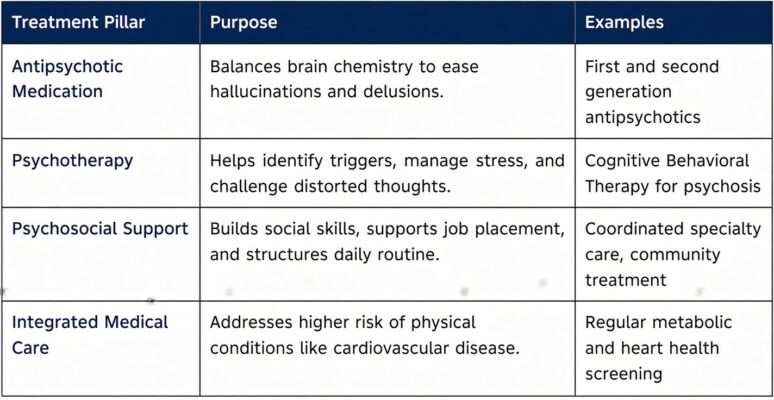
There is no cure, but schizophrenia is highly treatable, and many people go on to live stable, meaningful, independent lives. Effective care usually rests on four pillars working together.
Clearing Up a Common Misconception
Schizophrenia is not Dissociative Identity Disorder, and it is not “multiple personalities.” The word literally translates to “split mind,” but that split refers to a fragmentation from reality, not a fracture into separate personalities. It is also worth saying plainly: most people living with schizophrenia are not violent. They are far more likely to be victims of violence or neglect than perpetrators of it.
A Word From Nubi Wellness Center
Every story matters, and every diagnosis is a starting point, not a life sentence. With the right combination of medication, therapy, community support, and consistent care, people living with schizophrenia can and do build full, dignified lives. Faith, family, and a supportive community remain some of the strongest anchors on that journey, alongside professional treatment.
If you or someone you love is showing early signs of psychosis, changes in behavior, or emotional withdrawal, please do not wait to reach out. Early support changes outcomes.
Ready to Prioritize Your Mental Wellness?
Reach out to Nubi Wellness Center today. Book a consultation, ask a question, or simply take the first step toward whole-person healing. Click the blue box below to get started.

You Do Not Have to Carry It Alone
If this post resonated with you, our team at Nubi Wellness Center is here to walk with you through your healing journey. Reach out today, in confidence and without judgment.
Chat With Us on WhatsApp Visit Our Website09070990088 / 07054109566 • Every Story Matters. Every Healing Journey Counts.