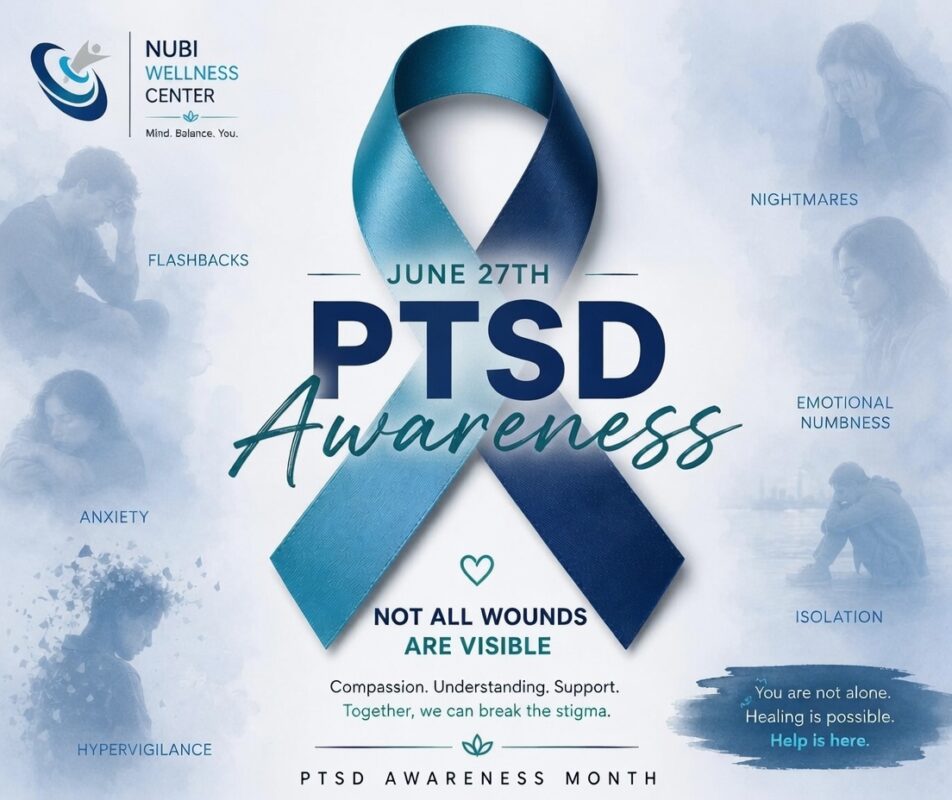
Some wounds bleed. Others bruise. But some wounds live quietly inside a person, invisible to everyone around them, yet present in every flinch, every sleepless night, every memory that will not stay buried. This is what Post-Traumatic Stress Disorder, commonly known as PTSD, looks like. It does not always show on the outside. But it is very real on the inside.
Every June 27th, the world observes PTSD Awareness Day, a moment dedicated to understanding post-traumatic stress disorder, breaking the silence around trauma, and reminding survivors that healing is possible. At Nubi Wellness Center, we believe this conversation matters deeply, especially here in Nigeria, where trauma is common but rarely named, and where so many people carry invisible wounds without ever being told there is a path to healing.
What Is PTSD, and Who Does it Affect?
PTSD is a mental health condition that can develop after a person experiences or witnesses a deeply distressing or life-threatening event. It is a normal nervous system response to an abnormal experience, the brain and body trying to protect themselves long after the danger has passed.
Many people only associate PTSD with soldiers and combat veterans, but the truth is far broader. PTSD affects civilians just as much as it affects military personnel. It can develop after road traffic accidents, armed robbery, kidnapping, domestic violence, sexual assault, childhood abuse, the sudden loss of a loved one, a difficult childbirth, a serious medical diagnosis, or surviving a natural disaster or community violence.
Research suggests that about 6 percent of people will experience PTSD at some point in their lives, and women are statistically more likely to develop it than men, often linked to higher rates of sexual violence and abuse. In Nigeria, where exposure to trauma, from insecurity, accidents, loss, and violence, is unfortunately common, the real number of people quietly living with PTSD is likely much higher than reported.
“What is ptsd and why it is not just stress”
Recognizing the Symptoms of PTSD
PTSD symptoms generally fall into four categories, and understanding them can help you recognize this condition in yourself or someone you love.
- Intrusive memories: Flashbacks, nightmares, or sudden waves of distress triggered by something that reminds the person of the traumatic event, a sound, a smell, a particular street, or even a date on the calendar.
- Avoidance: Steering clear of people, places, conversations, or even thoughts connected to the trauma. A survivor of a car accident might avoid driving altogether. A survivor of abuse might avoid being alone with certain people.
- Negative changes in mood and thinking: Feeling numb, hopeless, detached from others, or struggling to remember key details of the traumatic event. Some people feel a persistent sense of guilt, shame, or disconnect from the people they love.
- Hyperarousal: Being constantly on edge, easily startled, irritable, or struggling to sleep. The body stays in a state of alert, as though danger could return at any moment, even in safe, everyday situations.
These symptoms do not always appear immediately. For many people, they emerge weeks, months, or even years after the traumatic event, which is why PTSD is so often misunderstood or missed entirely.
PTSD Treatment: Why Healing Is Possible
If there is one thing we want every reader to walk away with today, it is this: PTSD is treatable, and recovery is absolutely possible. You do not have to carry this for the rest of your life.
At Nubi Wellness Center, we use evidence-based approaches to trauma treatment, including:
- Trauma-focused psychotherapy: Approaches like Cognitive Behavioral Therapy (CBT) and Prolonged Exposure Therapy help survivors process traumatic memories safely, with the guidance of a trained therapist, rather than avoiding them indefinitely.
- EMDR (Eye Movement Desensitization and Reprocessing): A specialized therapy that helps the brain reprocess traumatic memories, so they no longer carry the same emotional intensity.
- Medication support: In some cases, antidepressants or anti-anxiety medication, prescribed and monitored by a psychiatrist, can help manage severe symptoms while therapy does its deeper work.
- Holistic support: Mindfulness practices, regular movement or exercise, support groups, and a strong faith or community foundation can all complement professional treatment and support long-term healing.
Healing from trauma is rarely a straight line, but with the right support, the nightmares fade, the triggers lose their grip, and life begins to feel safe again.
“Click here to know the difference between ptsd and stress, and how it….”
What You Can Do Today
PTSD Awareness Day is not just about information. It is about action, however small. Here is where you can start:
- If something feels off, get screened. If you have been struggling with flashbacks, nightmares, or a constant sense of unease since a difficult experience, do not dismiss it. Speak to a licensed mental health professional for a proper assessment.
- Check on someone who survived something hard. A friend who lost a loved one. A relative who survived an accident or attack. A colleague who has seemed different since something happened. A simple, sincere check-in can mean more than you know.
- Share this conversation. The more we talk openly about PTSD and trauma, the less power stigma has over the people who need help the most.
A Final Word
If you are living with PTSD, know this. You are not broken. You are not overreacting. Your nervous system is doing exactly what it learned to do to keep you alive. With the right support, it can also learn that it is safe to put that guard down.
The wound may be invisible, but so is the healing happening underneath it, quietly, steadily, one safe day at a time.
You do not have to carry this alone. At Nubi Wellness Center, our trauma-informed therapists and psychiatric professionals in Lagos provide confidential PTSD treatment and trauma therapy tailored to your healing journey.

You Do Not Have to Carry It Alone
If this post resonated with you, our team at Nubi Wellness Center is here to walk with you through your healing journey. Reach out today, in confidence and without judgment.
Chat With Us on WhatsApp Visit Our Website09070990088 / 07054109566 • Every Story Matters. Every Healing Journey Counts.